

Volcanic eruptions threaten one in ten people on Earth. The threat is under-estimated by exposed communities because most major eruptions occur from volcanoes that have been quiet for 100 years or more. The intervals are long enough for volcanoes to remain unmonitored. When unrest returns, forecasts of eruption often rely on data from hastily-installed monitoring networks. The forecasts contain large uncertainties, which hinder hazard mitigation and diminish the trust of vulnerable communities. A compelling social need therefore exists for reliable forecasts of eruptions at long-quiescent volcanoes, using emergency data obtained after the start of unrest.
Volcano-tectonic (VT) events (or local micro-earthquakes), supported by ground movement, are the most reliable precursors to eruptions after extended repose. They show similar patterns before an eruption, independent of tectonic setting, magma composition, and style of activity. How their behaviour changes with time is used to indicate whether an eruption is imminent. Critical pre-eruptive rates are estimated from time series using multivariate statistics, empirical analysis and expert elicitation. However, the evaluations are uncertain, because (1) individual precursors are treated as independent quantities and so constraints from any mutual dependence are lost, and (2), owing to long repose intervals, data from previous eruptions at a given volcano are often not available and so thresholds are extrapolated from unrest at other volcanoes that are believed to be similar.
Empiricism is a weakness that has prevented breakthroughs in objective forecasting for more than thirty years. It has been encouraged by the popular starting assumption that volcanic systems are too complex to follow a shared set of pre-eruptive trends. We challenge this view. After long repose, volcanoes must break open a pathway through the crust before magma erupts. The fundamental mechanics of crustal rupture occurs under restricted ranges of physical conditions and these, in turn, promote repeatable and quantifiable patterns of deformation and fracture.
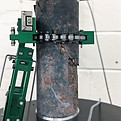
We propose that deformation and fracture can be used to measure the pre-eruptive stability of a volcano and, from this, to allow deterministic forecasts of eruption far enough ahead of time to be of practical value. We have created a new physical model that transforms VT seismicity and ground deformation into natural stress and strain meters, without empirical approximations. Our goal is to validate the model against data from novel laboratory experiments and from comprehensive field observations. Our ambition is to deliver a step change in the reliability of forecasts and so advance the protection of communities under threat.
Key Themes

Theory
Experiments
